
What Is Technical Diving – and Why Learn in Mahahual?

Have you ever swum over the edge of a reef and looked down? The coral continues below you. The water gets darker. Bigger barrel sponges appear further down the slope, and somewhere beneath you the reef disappears into the blue. You want to keep going — but your computer is already telling you it's time to turn around.
That's where technical diving begins.
Technical diving isn't really about collecting depth numbers. It's about being able to go beyond the limits of recreational diving and explore more, stay longer and go deeper.
And in Mahahual, there's a very good reason to do it.
The reefs most divers know are only part of Mahahual's underwater landscape. Continue deeper and the reef changes — huge barrel sponges, black coral, larger reef formations and, eventually, a drop-off disappearing into the blue. Technical diving gives us the training, equipment and skills to explore beyond recreational limits.
That's what the PADI TecRec pathway is really about: learning to plan and conduct increasingly challenging dives and, most importantly, bring yourself and your team safely back.
It's Not Just About Going Deeper
Technical diving can look like it's all about depth — 40 metres with Tec 40, 45 metres with Tec 45 and 50 metres with Tec 50. Each course progressively extends what you're trained to do, but simply getting deeper isn't really the point.
Going deeper opens up places we couldn't otherwise reach, but having time to explore them is just as important. On a recreational dive, you can reach an interesting part of a deeper reef only to find your no-decompression time disappearing almost as soon as you get there.
Technical diving changes that. With the appropriate training, equipment, gas and planning, we can deliberately plan decompression dives and spend meaningful time exploring beyond recreational limits.
Instead of simply asking “How deep can I go?”, the more interesting question becomes
“What can I do while I'm there?”
Depth gives us access; time lets us explore.
Going Down Is the Easy Part
Think back to your Open Water course. One of the first times you probably experienced real task loading was underwater navigation. Follow the compass, control your buoyancy, watch your depth, keep track of your buddy and look where you're going. Suddenly, something as simple as swimming in a straight line wasn't quite so simple.
Technical diving takes that considerably further — particularly on the way back up.
You're maintaining buoyancy and trim while controlling your ascent, communicating with your team and following your decompression plan. You may be deploying a DSMB or switching gases, identifying and verifying the correct gas before you breathe from it. All of that needs to happen while you remain aware of your team, your surroundings and what's happening around you.
None of those individual skills is particularly remarkable. The challenge is doing all of them correctly, at the right time, while maintaining control of the dive.
That's why I say going down is easy. Coming back up is the challenge.
Technical Diving Starts Before the Dive
There's another big difference that isn't as obvious in the photos: preparation. Technical diving means more equipment, more gas, more planning and more checks. We generally dive as a team, but being part of a team doesn't reduce your individual responsibility — it increases it.
You need to know your equipment and gases, understand the plan and make sure everything is correctly configured and working before you enter the water. Your teammates are there to support you; they're not there to compensate for poor preparation. That's one of the biggest mindset changes when moving into technical diving.
Why Are Technical Divers Carrying So Much Stuff?

Because much of it is there for a reason: redundancy. Take twin cylinders. They aren't simply two tanks because we want lots of gas. Properly configured, they give us the ability to deal with certain equipment or gas-system failures while still maintaining access to our gas.
The same thinking continues through the rest of our equipment. We may carry two computers, a backup mask, multiple lights and backup methods for completing important parts of the dive. But carrying redundant equipment isn't what makes this work. Training does.
If something fails, you need to recognise the problem, know what to do about it and work with your team to bring the dive to a safe conclusion. The equipment gives you options; training teaches you how to use them.
Not every piece of technical diving equipment is about redundancy. A DPV can completely change the way we explore a site. Instead of using much of our gas and time swimming to the part of the reef we want to explore, a DPV lets us cover considerably more distance with less effort. On Mahahual's deeper reefs, that can mean exploring much more of the reef during a planned technical dive.
For me, technical diving and DPVs are a natural combination — one gives us the time and depth, while the other gives us the range.
You Might Be Closer Than You Think
Technical divers covered in cylinders and equipment can look a little intimidating. It's easy to assume you need hundreds — or thousands — of dives before you can even think about starting. You don't.
For PADI Tec 40, the minimum requirements include being at least 18, being a PADI Advanced Open Water Diver and Enriched Air (Nitrox) Diver, having the Deep Diver Specialty or the required deep-diving experience, and having at least 30 logged dives.
Does having 30 dives automatically mean you're ready for technical diving? No. It means we can start the conversation. Your comfort in the water, buoyancy, awareness, experience and attitude matter considerably more to me than simply reaching a number in your logbook. But you might be closer to taking that first step than you thought.
From Tec 40 to Tec 50

The PADI TecRec pathway develops progressively. Tec 40 is the first step into planned decompression diving. You begin learning technical equipment configurations, gas planning, decompression procedures and how to respond when things don't go according to plan.
Tec 45 builds on that foundation, taking you deeper and developing your ability to manage more involved technical dives, while Tec 50 takes the progression to 50 metres and more substantial decompression diving.
I don't particularly like thinking of them simply as three increasingly deep certifications. The important progression is what's happening to you as a diver. Your trim and propulsion improve. You become more comfortable with the equipment and learn to manage multiple gases. You become better at solving problems while maintaining buoyancy and awareness, and you learn to plan decompression dives and then actually execute the plan.
Eventually all of that training gives you something much more interesting than another certification card: it gives you somewhere new to go.
So Let's Go Diving at La Rampa
La Rampa is one of my favourite dive sites in Mahahual. As you move deeper, the reef begins sloping away, and around 30 metres you can look down and see it continuing beneath you. It's very easy to wonder: What's down there?
The temptation can be to follow the slope towards 40 or 45 metres, have a quick look and head shallower as your no-decompression time disappears. But that's exactly the wrong way to approach deeper diving. We've seen tragic real-world examples of what can happen when divers go beyond their training or equipment.
Technical training lets us approach that same reef very differently. Instead of asking “Can I quickly go down there and have a look?”, we can ask:
“How can we plan a dive that lets us go down there, actually explore it, and come back safely?”
Thirty Minutes at 40 Metres
Let's imagine we're planning 30 minutes at 40 metres at La Rampa. Before we even get wet, we know exactly what we're planning to do. We've calculated our gas and reserves, planned our decompression and ascent, checked our equipment and discussed the dive as a team — including what we'll do if something doesn't go according to plan.
Then we go diving.
We're not accidentally finding ourselves at 40 metres watching our no-decompression time disappear. We intended to be there. And that changes the dive completely.
Now we have meaningful time to explore. We can follow the reef, look around and actually enjoy being there rather than touching 40 metres and immediately thinking about getting shallower.
When our planned bottom time is up, coming back isn't an afterthought — it's part of the dive. We ascend together, control our ascent rate, make the planned gas switch and complete our decompression.
All those skills we've been practising suddenly have a purpose.
And This Is Why I Love Technical Diving in Mahahual
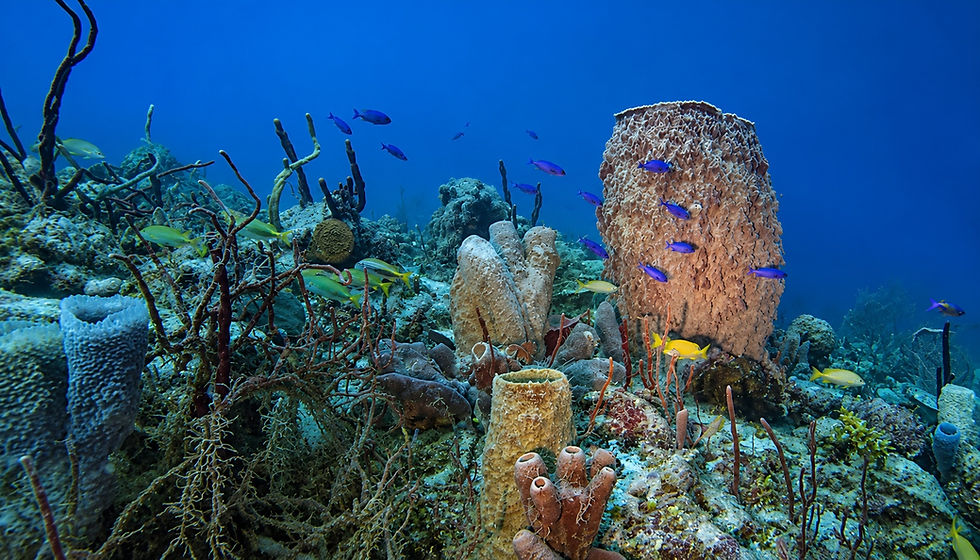
Follow La Rampa deeper and eventually the slope reaches a dramatic drop-off. Suddenly Mahahual looks very different. There are huge barrel sponges, black coral and reef formations that most recreational divers here never see. There can be grouper, barracuda, sharks and other marine life, while beside you the drop-off disappears into much deeper water.
That's the moment when all the equipment, planning, drills and training make sense. This isn't about looking at your computer and being pleased because it says 40 or 45 metres. It's about where that depth allowed you to go.
Why Learn Technical Diving in Mahahual?

Warm Caribbean water helps. Generally excellent visibility helps. Having areas where we can develop skills before progressively taking them deeper certainly helps. But there's another reason I think Mahahual is particularly good for learning technical diving: we have somewhere worth going.
At Tec 40, you can start applying technical skills and limited decompression diving in a real environment. As you progress through Tec 45 and Tec 50, the diving progresses with you. Rather than simply descending to a training depth, completing exercises and coming back up, we can use those developing skills to actually explore.
Technical diving will make you think more. It will demand more preparation and more individual responsibility. You'll improve your trim and propulsion, learn to manage more complex equipment, solve problems, work with multiple gases and manage decompression dives.
But none of those things are the real reason I love it. They're what allow us to do the thing we actually came diving for:
Explore more. Stay longer. Go deeper — and see some really cool things along the way.

Want to see what's down there?
Whether that means taking your first step into technical diving, exploring more of Mahahual's reefs with a DPV, or simply talking about where you want your diving to take you next — let's go diving.


Comments